Coquina: Florida's ancient shell rock
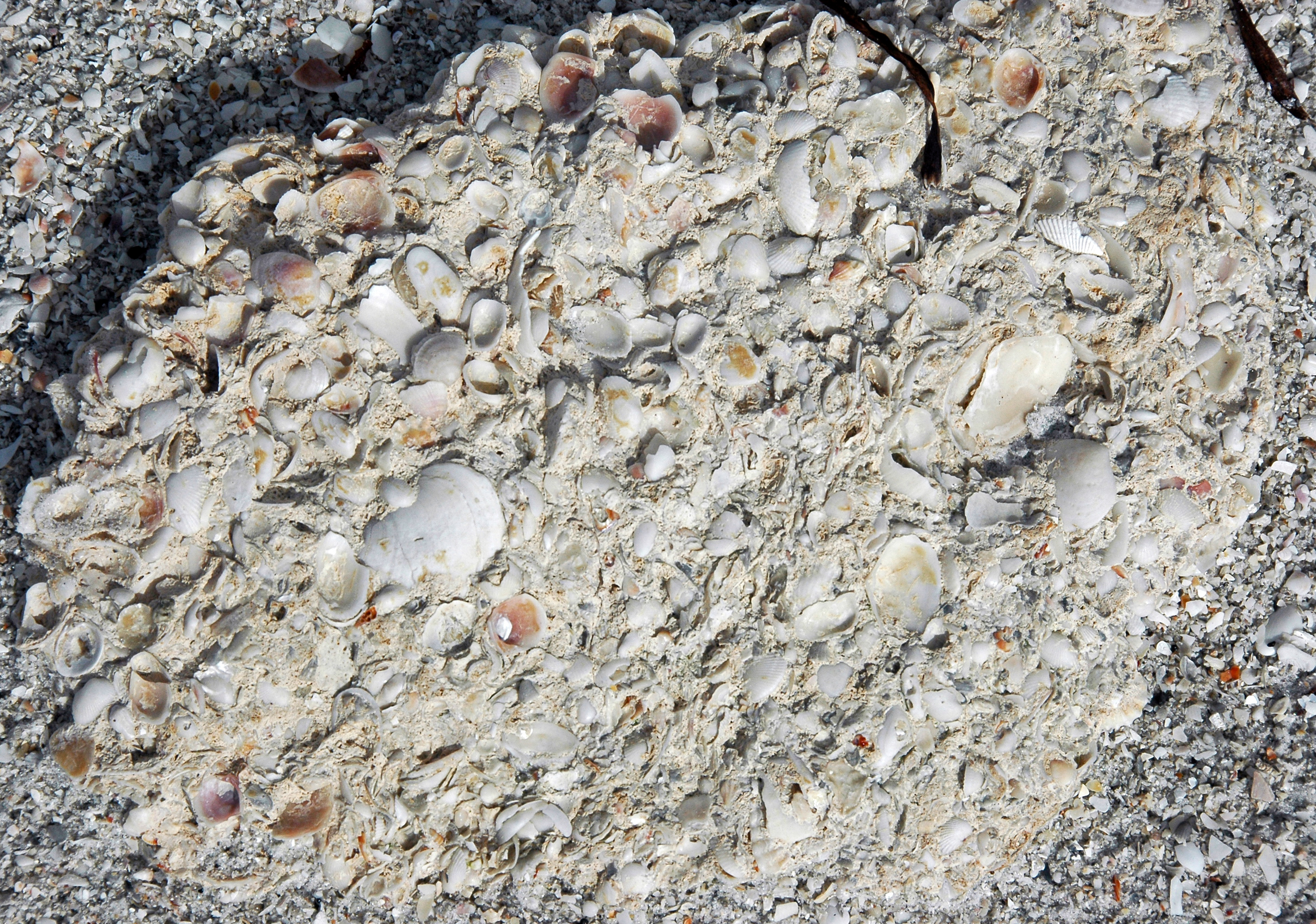
Along the Atlantic coast of Florida, you can find a rock that looks like it was assembled by the sea itself, because it was. Coquina is one of the most visually distinctive rock types in the state, its surface studded with the recognizable shapes of clam shells, snail shells, and coral fragments cemented into a solid mass. This humble sedimentary rock has served Florida in ways far beyond its geological role. Coquina built fortifications that withstood cannon fire, lined roads across the peninsula, and today continues to protect the coastline from erosion.
How coquina forms
Coquina begins as an accumulation of loose shells and shell fragments on beaches and shallow seafloors. In Florida's case, the primary source of shell material is the rich marine life of the Atlantic coastal waters. As generations of mollusks, corals, barnacles, and other calcareous organisms live and die, their hard parts accumulate in enormous quantities.
The transformation from loose shell debris to solid coquina rock occurs through a geological process called diagenesis. Here is how it works:
- Accumulation: Shells and shell fragments are deposited by wave action, creating thick beds of unconsolidated shell hash in nearshore and beach environments.
- Compaction: As additional sediment buries the shell beds, the weight of overlying material compresses the shells together, reducing pore space.
- Cementation: Groundwater percolating through the shell beds dissolves calcium carbonate from some shells and re-precipitates it as cement in the spaces between remaining fragments. This precipitated calcium carbonate acts as a natural glue, binding the shells into solid rock.
- Lithification: Over thousands of years, continued cementation transforms the shell bed into hard coquina rock. The degree of cementation determines the rock's hardness: some coquina crumbles easily, while well-cemented specimens are remarkably durable.
In Florida, the most extensive coquina deposits formed during Pleistocene interglacial periods (roughly 126,000 to 11,700 years ago) when sea levels were higher than today and warm, shallow waters supported abundant marine life. These deposits now make up much of the Anastasia Formation.
Composition of Florida coquina
The composition of Florida coquina varies depending on the depositional environment and the organisms that contributed to the shell bed. Common components include:
- Bivalve shells: Clams, oysters, scallops, and ark shells are among the most common constituents. Their flat, curved shell fragments are easily recognizable in the rock.
- Gastropod shells: Snail shells, including whelks, moon snails, and other marine gastropods, appear as spiral-shaped fragments.
- Coral fragments: Pieces of branching and massive coral species contribute to coquina, particularly in formations closer to ancient reef environments.
- Echinoderm fragments: Sea urchin spines and test plates occasionally appear in coquina, adding to its textural complexity.
- Quartz sand: Fine to medium quartz sand grains are often mixed with the shell material, particularly in coquina deposits that formed in beach environments.
- Calcium carbonate cement: The binding agent that holds everything together, precipitated from groundwater during diagenesis.
This diverse assemblage of biological components makes coquina a type of bioclastic limestone, a limestone formed primarily from broken fragments of biological origin. The composition of Florida beach sand today reflects similar processes, with shell fragments being a major component.
Coquina as a building material
The most famous use of Florida coquina is the construction of the Castillo de San Marcos in St. Augustine, the oldest masonry fort in the continental United States. Spanish engineers began construction in 1672, using coquina quarried from Anastasia Island directly across Matanzas Bay.
The Spanish initially considered coquina a poor substitute for the hard building stones available in Europe. However, coquina proved to have a property that made it ideal for military fortifications: when struck by cannonballs, coquina did not shatter like harder stones. Instead, the porous, somewhat elastic rock absorbed the impact, with cannonballs embedding themselves in the walls rather than causing catastrophic fractures.
This was demonstrated dramatically during the British siege of 1702, when English forces bombarded the Castillo for 50 days. The coquina walls withstood the assault, with cannonballs simply sinking into the soft rock. The fort, and the people sheltering inside, survived. No other building stone available in the region could have performed as well under bombardment.
Beyond the Castillo de San Marcos, coquina was used extensively throughout colonial and early American Florida:
- Fort Matanzas, a smaller fortification south of St. Augustine, was also built from coquina.
- Many historic buildings in St. Augustine's colonial quarter feature coquina walls.
- Early Florida roads were surfaced with crushed coquina, a practice that continued into the twentieth century.
- Seawalls and foundations along the Atlantic coast were constructed with quarried coquina blocks.
Where to find coquina in Florida
Coquina is widespread along Florida's Atlantic coast, wherever the Anastasia Formation is present. Key locations include:
St. Augustine area
The historic quarries on Anastasia Island provided the stone for the Castillo de San Marcos and other colonial structures. Today, Anastasia State Park preserves some of these quarry sites, and natural coquina outcrops are visible along the beach.
Washington Oaks Gardens State Park (Flagler County)
This park has wave-sculpted coquina outcrops along its beach that draw photographers and geology enthusiasts alike.
Blowing Rocks Preserve (Martin County)
On the Treasure Coast, this preserve on Jupiter Island features impressive coquina exposures where wave action has carved solution holes and blowholes into the rock. The site demonstrates coquina's role in coastal formation and protection.
Beaches throughout the Treasure Coast
Coquina rock is frequently exposed at low tide on beaches in St. Lucie, Martin, and Indian River counties. After storms, wave erosion may reveal previously buried outcrops, providing temporary windows into the geological substrate beneath the beach sand.
Coquina and coastal erosion protection
In an era of rising sea levels and intensifying coastal storms, coquina's role as a natural breakwater is gaining renewed appreciation. Where coquina outcrops are present along the shoreline, they dissipate wave energy, slow longshore sediment transport, and provide anchor points for beach sediment accumulation.
Coastal scientists studying erosion patterns along Florida's Atlantic coast have documented that stretches of shoreline underlain by intact coquina retreat significantly more slowly than adjacent areas lacking rock substrate. This natural protection is particularly valuable on the Treasure Coast, where the Treasure Coast ecosystem depends on stable shoreline conditions.
However, coquina is not indestructible. Chemical weathering, the dissolution of the calcium carbonate cement by slightly acidic rainwater and seawater, gradually weakens the rock over time. Physical weathering from wave impact, abrasion by sand, and biological boring by organisms such as sponges and bivalves also take their toll. As ocean chemistry changes due to increasing atmospheric carbon dioxide, the rate of chemical dissolution may accelerate, potentially threatening coquina outcrops over coming centuries.
Identifying and collecting coquina
Coquina is one of the easiest rocks to identify in the field. Look for these characteristics:
- Visible shell fragments: The defining feature of coquina. Individual shells should be recognizable, even if broken.
- Rough, porous texture: Coquina feels rough to the touch and typically has visible pore spaces between shell fragments.
- Tan to light brown color: Fresh coquina ranges from cream to light tan. Weathered surfaces may appear gray, brown, or stained by iron oxides.
- Reacts with acid: Like all limestones, coquina fizzes when a drop of dilute hydrochloric acid is applied, confirming its calcium carbonate composition.
- Variable hardness: Some coquina crumbles easily between your fingers; well-cemented specimens require a hammer to break.
If you wish to collect coquina specimens, remember that collecting is prohibited in state and national parks, preserves, and other protected areas. On public beaches outside protected zones, small samples collected for personal, non-commercial use are generally acceptable, but check local ordinances. For serious collectors, construction sites and authorized quarries sometimes offer opportunities to obtain larger or better-quality specimens with permission.
Frequently asked questions about coquina
Is coquina the same as coral rock?
No. While coquina may contain coral fragments, it is composed primarily of cemented shell fragments: clams, snails, and other mollusks. Coral rock (such as the Key Largo Limestone in the Florida Keys) is formed primarily from the skeletons of reef-building corals. The two are distinct rock types with different compositions and formation processes, though both are calcium carbonate-based.
How old is the coquina in Florida?
Most of Florida's coquina was deposited during the Pleistocene epoch, roughly 126,000 to 11,700 years ago. The most extensive coquina deposits belong to the Anastasia Formation, which formed primarily during the Sangamonian interglacial period (about 126,000–110,000 years ago). However, smaller, younger coquina deposits continue to form along Florida's beaches today.
Can coquina form today?
Yes. The process of coquina formation is ongoing wherever shell-rich sediments are exposed to calcium carbonate-rich groundwater. "Beach rock," recently cemented coastal sediment, forms along Florida's coast today and represents incipient coquina. However, these modern deposits are typically only a few hundred to a few thousand years old and are generally less well-cemented than ancient coquina.
Why did the Spanish choose coquina for the Castillo de San Marcos?
Pragmatism, primarily. Coquina from nearby Anastasia Island was the only available building stone in the St. Augustine area. The Spanish would have preferred harder European-style building stone but found that coquina's softness was actually an advantage: it absorbed cannonball impacts rather than shattering. This accidental benefit made the Castillo de San Marcos one of the most resilient fortifications in colonial America.
Is coquina found outside of Florida?
Yes. Coquina deposits occur in coastal areas around the world wherever conditions favor the accumulation and cementation of shell-rich sediments. Notable coquina deposits exist along the coasts of North Carolina, the Caribbean, Brazil, Australia, and the Mediterranean. However, Florida's Anastasia Formation contains some of the most extensive and well-studied coquina deposits in North America.