The Anastasia Formation: Florida's Coastal Foundation
If you have ever walked along a rocky stretch of Florida's Atlantic coast and noticed rough, shell-studded rock exposed at the waterline, you were almost certainly looking at the Anastasia Formation. This geological unit is one of the most visible and accessible rock formations in the state, and it plays a far more important role than most beachgoers realize. The Anastasia Formation is the bedrock foundation of eastern Florida's coastline, a natural seawall that has been absorbing wave energy and shaping shoreline dynamics for more than one hundred thousand years.
Geographic Extent of the Anastasia Formation
The Anastasia Formation stretches along approximately 250 miles of Florida's Atlantic coast. Its northernmost exposures occur near St. Augustine in St. Johns County, and the formation takes its name from Anastasia Island, where some of the most prominent outcrops are found. From there, it extends south through Flagler, Volusia, Brevard, Indian River, St. Lucie, Martin, and into Palm Beach County.
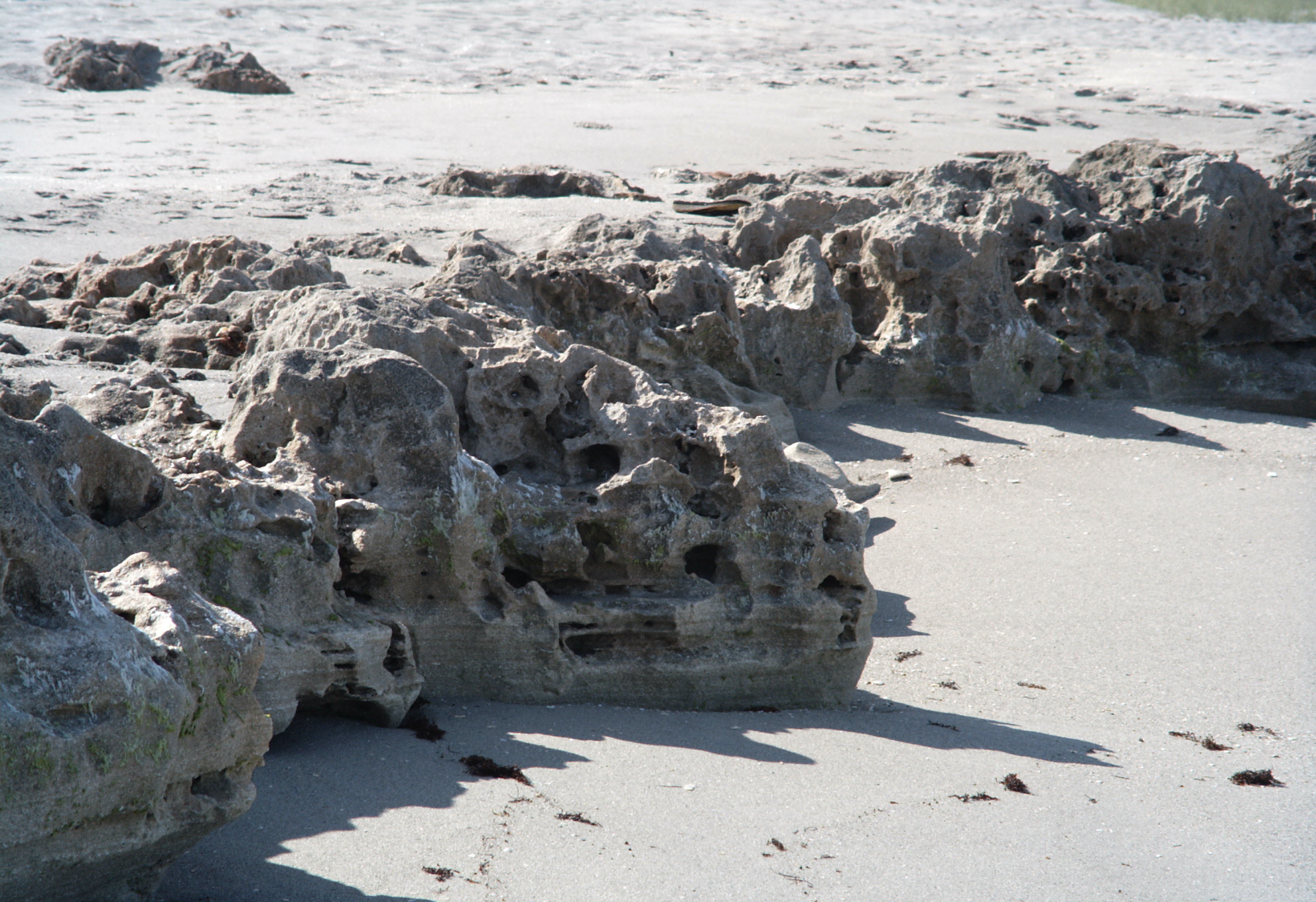
On the Treasure Coast, the Anastasia Formation is particularly significant. In St. Lucie, Martin, and Indian River counties, this formation underlies barrier islands such as Hutchinson Island and Jupiter Island, forming the rocky substrate visible at places like Blowing Rocks Preserve in Martin County. Here, the Anastasia Formation creates dramatic rocky shorelines where wave action has carved solution holes, overhangs, and blowholes into the coquina limestone.
Composition and Physical Characteristics
The Anastasia Formation is classified as a coquina limestone, though its composition varies considerably along its geographic extent. The primary components include:
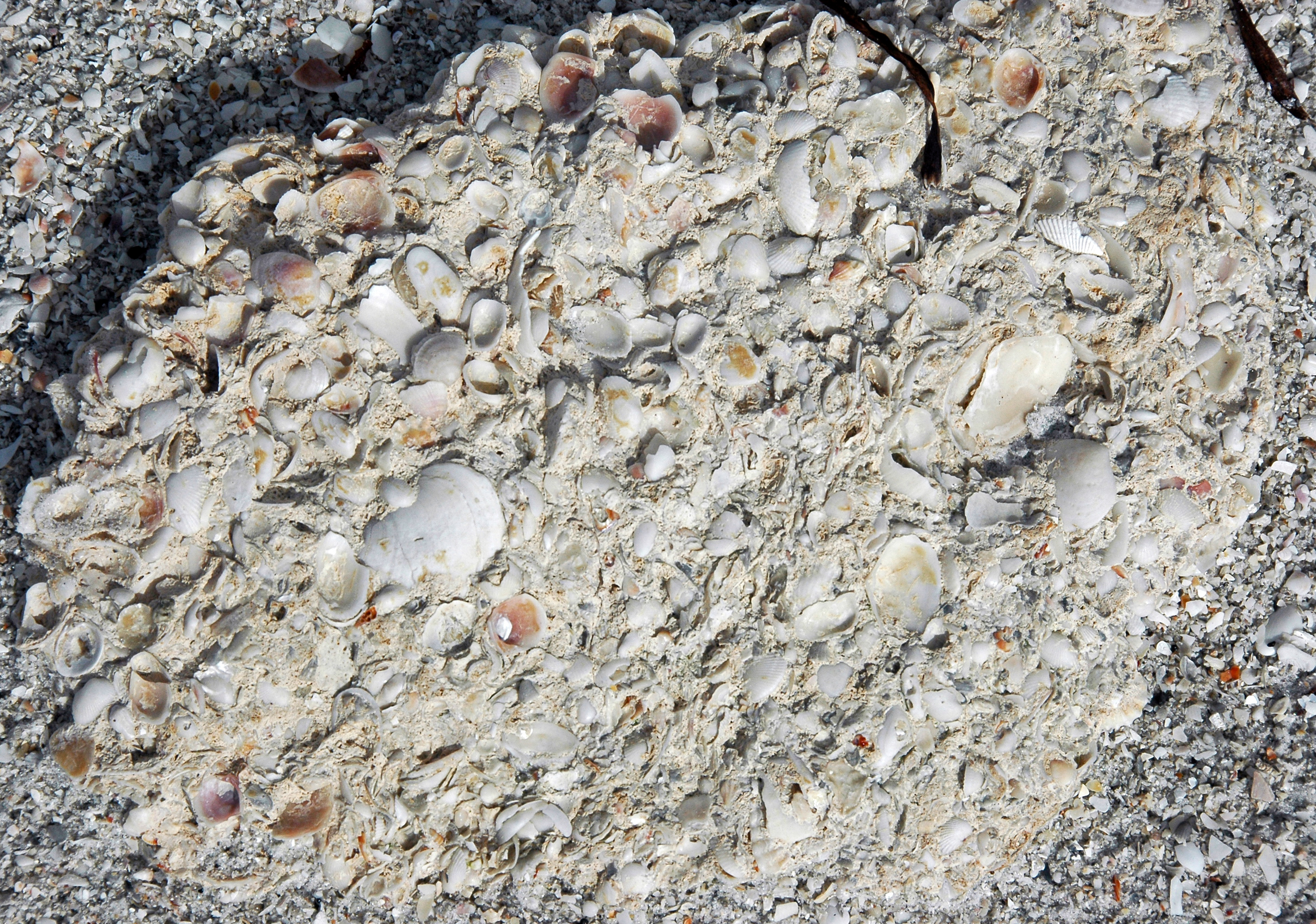
- Shell hash: Broken and whole shells of marine mollusks, including clams, oysters, scallops, and gastropods, make up a significant portion of the rock. These shell fragments give the Anastasia Formation its characteristic rough, porous texture.
- Quartz sand: Fine to medium quartz grains, transported southward along the coast by longshore drift from eroding Appalachian source rocks, are cemented within the shell matrix.
- Calcium carbonate cement: The shells and sand are bound together by calcium carbonate precipitated from groundwater, a process called cementation that transforms loose sediment into solid rock.
- Coral fragments: In the southern portions of the formation, fragments of reef-building corals become more common.
The rock ranges in hardness from weakly cemented, crumbly material to dense, well-indurated limestone. This variation reflects differences in the original sediment composition and the degree of post-depositional cementation. Generally, the Anastasia Formation becomes better cemented and harder with depth and age.
Age and Formation Process
The Anastasia Formation was deposited during the Pleistocene epoch, primarily during interglacial periods when sea levels were higher than they are today. Most of the formation dates to the Sangamonian interglacial period (approximately 126,000 to 110,000 years ago), though some deposits may extend into earlier or later Pleistocene interglacials.
During these warm periods, sea levels stood 20 to 30 feet higher than present. The Atlantic coastline was farther west, and the shallow nearshore waters provided ideal conditions for the accumulation of shell-rich sediments. As marine organisms lived and died in these nearshore environments, their shells accumulated on the seafloor and in beach deposits. Over time, calcium carbonate dissolved from the shells themselves re-precipitated as cement, binding the loose sediment into solid rock.
This process of cementation, technically called diagenesis, was accelerated during periods when sea levels dropped and the sediments were exposed to freshwater percolation. Rainwater slightly acidic from dissolved carbon dioxide would dissolve calcium carbonate in one zone and re-precipitate it in another, gradually lithifying the deposit into the coquina limestone we see today. The full geological timeline of Florida places this formation in the broader context of the state's Pleistocene history.
Where to See the Anastasia Formation
The Anastasia Formation is one of the most accessible geological units in Florida. Notable locations include:
Washington Oaks Gardens State Park (Flagler County)
One of the best-known exposures of the Anastasia Formation, Washington Oaks features a coquina rock beach where wave-sculpted outcrops create a striking landscape. The park's Atlantic shoreline provides an excellent opportunity to examine the rock's shell-rich composition up close.
Anastasia State Park (St. Johns County)
The formation's namesake location on Anastasia Island near St. Augustine features coquina exposures along the beach and intertidal zone. The historic coquina quarries that provided building stone for the Castillo de San Marcos are also nearby.
Blowing Rocks Preserve (Martin County)
Managed by The Nature Conservancy, this Treasure Coast preserve features the largest outcrop of Anastasia Formation limestone on the Atlantic coast. During high seas and strong winds, wave action forces water through solution holes in the rock, creating spectacular plumes of spray, hence the name "Blowing Rocks." This site dramatically demonstrates the Anastasia Formation's role in Florida's coastline formation.
How to Recognize Anastasia Limestone in the Field
You do not need a hand lens to identify the Anastasia Formation, but you do need to know that it looks like two different rocks depending on which surface you are standing on. A weathered outcrop reads as grey to buff, deeply pitted, and honeycombed with holes, and from a few feet away the shells are not obvious at all. Break a piece open, or find a freshly eroded face, and the rock turns pale cream and the shells are suddenly everywhere: clams, oysters, scallops and snails packed together with quartz sand cemented into the spaces between them, and coral fragments appearing more often toward the southern end of the formation. Hardness varies a great deal from outcrop to outcrop, from material you can crumble in your fingers to rock hard enough to have been quarried for building stone.
Where the rock meets the sea, wave action leaves a second set of clues. Solution holes, undercut overhangs, and blowholes are characteristic of exposed Anastasia limestone, so a shoreline of low, pitted ledges standing just above the sand line is a reliable sign that you are looking at the formation itself and not at cemented material of some more recent origin.
Two rocks are commonly mistaken for it. Beach rock is much younger, cemented within the last few thousand years in the intertidal zone, and typically forms thin slabs lying parallel to the present shoreline rather than the thick, irregular ledges of the Anastasia Formation. Miami Limestone, the oolitic and bryozoan limestone that underlies southeastern Florida from roughly Palm Beach County south, is built from ooids, small rounded carbonate grains resembling fish roe, rather than from recognizable shell fragments. Palm Beach County is where the two units meet, which makes it the one stretch of coast where the grain of the rock tells you more than its setting does.
Significance for Coastal Protection
The Anastasia Formation functions as a natural seawall along much of Florida's Atlantic coast. Where the rock is exposed or lies just beneath the surface, it provides critical resistance to wave erosion and storm surge. During hurricanes and nor'easters, the Anastasia Formation absorbs enormous wave energy that would otherwise accelerate shoreline retreat.
Coastal engineers and geologists recognize the Anastasia Formation as an irreplaceable asset for shoreline stability. Unlike artificial seawalls and beach nourishment projects, the natural rock formation has maintained the position of Florida's Atlantic coastline for thousands of years. Where the formation is absent or has been eroded, coastal retreat tends to be more rapid.
The porous nature of the Anastasia Formation also plays a role in beach sand dynamics. The rock acts as a reservoir, trapping sand in its solution holes and crevices during calm periods and releasing it during storms, contributing to the natural sediment budget of adjacent beaches.
Groundwater and the Surficial Aquifer
Below the surface, the Anastasia Formation serves as a major component of the Surficial Aquifer System, the uppermost aquifer in eastern Florida. The porous, permeable nature of the coquina limestone allows it to store and transmit significant quantities of groundwater.
On the Treasure Coast and throughout the formation's extent, the Surficial Aquifer within the Anastasia Formation is an important water resource. Shallow wells tap this aquifer for irrigation and, in some areas, for drinking water supply. The aquifer is recharged directly by rainfall percolating through the permeable rock, making it responsive to seasonal precipitation patterns. Understanding the Anastasia Formation's hydrogeological properties is essential for managing water resources across eastern Florida.
What to Call It: Formation, Limestone, or Coquina
Three names circulate for what is largely the same rock, which is why searches for one of them often turn up the others. Anastasia limestone is the everyday name for the rock itself, the shell-and-sand limestone you can put a hand on. Anastasia Formation is the formal stratigraphic name for the mapped body of rock that limestone belongs to, the term a geologist or a well log will use. Coquina is the rock type, and it is the broadest of the three: it describes any limestone built predominantly of cemented shell fragments, in Florida or anywhere else.
The terms "Anastasia Formation" and "coquina" are closely related but not interchangeable. Coquina is a rock type, a sedimentary limestone composed predominantly of cemented shell fragments. The Anastasia Formation is a stratigraphic unit, a formally named geological formation that happens to be composed largely of coquina.
Not all coquina in Florida belongs to the Anastasia Formation, and not all of the Anastasia Formation is pure coquina. The formation also includes zones of sandy limestone, cemented sandstone, and unconsolidated shell beds. However, the characteristic coquina facies, rough, porous, and shell-rich limestone, is the most recognizable and widespread component of the Anastasia Formation.
Research and Conservation
The Anastasia Formation continues to be an active subject of geological research. Scientists at the Florida Geological Survey and universities across the state study the formation to understand Pleistocene sea level history, coastal geomorphology, and groundwater resources. The formation's fossil content, including marine mollusks, corals, and echinoids, provides valuable data about past environmental conditions.
Conservation of Anastasia Formation outcrops is increasingly important as coastal development accelerates. Where the formation has been quarried, excavated, or covered by construction, its natural coastal protection function is diminished. State and local conservation efforts aim to preserve key outcrops and limit activities that could compromise the formation's structural integrity.
Frequently Asked Questions About the Anastasia Formation
How thick is the Anastasia Formation?
The thickness of the Anastasia Formation varies from a few feet to over 100 feet, depending on location. Generally, the formation thickens from north to south and from the coastline toward the interior. In some areas of the Treasure Coast, the Anastasia Formation reaches thicknesses of 50 to 80 feet.
Can I collect rocks from the Anastasia Formation?
Collecting rocks from state parks, national seashores, or protected areas is generally prohibited. On public beaches outside of protected areas, collecting small samples for personal use is usually permitted, but check local regulations. Never remove rocks from areas where doing so could accelerate erosion or damage natural features.
Is the Anastasia Formation the same as beach rock?
No. Beach rock is a recently cemented coastal deposit, typically only a few hundred to a few thousand years old, formed when beach sand is cemented by calcium carbonate in the intertidal zone. The Anastasia Formation is a much older geological unit (Pleistocene age) that has undergone more extensive diagenesis and compaction. However, the two can appear similar at first glance and sometimes occur in close proximity.
Does the Anastasia Formation contain fossils?
Yes. The Anastasia Formation contains abundant marine fossils, including shells of clams, oysters, scallops, and gastropods, as well as coral fragments, sea urchin spines, and occasionally vertebrate remains. These fossils are important for dating the formation and reconstructing the marine environments of Pleistocene Florida. For more on Florida fossils, see our Treasure Coast fossil hunting guide.