Megalodon teeth in Florida: a collector's guide
What are megalodon teeth in Florida?
Megalodon teeth in Florida are fossilized teeth from Otodus megalodon, the largest shark species that ever lived, found within the state's rivers, beaches, phosphate deposits, and offshore waters. These teeth range from under one inch to over seven inches in length and are preserved in sedimentary formations dating to the Miocene and Pliocene epochs (approximately 23 to 3.6 million years ago). Florida is among the best-known places in the world to collect megalodon teeth because of its extensive phosphate-bearing geological formations, accessible waterways, and favorable preservation conditions.
What was Otodus megalodon?
Otodus megalodon was the largest predatory shark, and one of the largest predatory fish, to ever inhabit Earth's oceans. This massive animal lived during the Miocene and Pliocene epochs, roughly 23 to 3.6 million years ago, and patrolled warm, shallow seas across the globe. Estimates of its maximum size range from 50 to 65 feet in length, approximately three times the length of a modern great white shark, with a body mass potentially exceeding 50 tons.
Like all sharks, megalodon possessed a cartilaginous skeleton that rarely fossilized. What did fossilize, in great numbers, were its teeth. A single megalodon may have produced and shed over 20,000 teeth during its lifetime, and the species persisted for nearly 20 million years. This combination of prolific tooth production and deep geological time explains why megalodon teeth in Florida and elsewhere are found in far greater numbers than the teeth of many other extinct sharks.
Megalodon's diet likely included whales, dolphins, sea turtles, and other large marine animals. Its teeth were specifically adapted for grasping and shearing large prey: broad, triangular, finely serrated, and robust enough to bite through bone. These same characteristics make megalodon teeth in Florida instantly recognizable and highly prized among fossil collectors.
The species went extinct approximately 3.6 million years ago, during the late Pliocene. The causes of its extinction are debated but likely involved a combination of cooling ocean temperatures, declining prey availability, and competition from newly evolving predators including ancestors of the modern great white shark.
Why Florida is prime territory for megalodon teeth
Florida is one of the richest sources of megalodon teeth anywhere, and the geological reasons for that abundance are well understood. During the Miocene and Pliocene, when megalodon thrived, Florida was partially submerged beneath warm, shallow seas that provided ideal habitat for large marine predators and their prey. The extensive continental shelf surrounding the Florida Platform created vast stretches of productive shallow water where megalodon hunted.
As megalodon teeth fell to the seafloor, they became incorporated into accumulating sediments that were rich in phosphate minerals. This phosphate, derived from the weathering of ancient rocks and the decay of marine organisms, played a crucial role in the preservation and mineralization of megalodon teeth in Florida. The phosphate-rich environment replaced the original tooth material with dense, durable minerals that have survived millions of years of burial and subsequent exposure.
The Bone Valley Formation in central Florida is the epicenter of this phosphate-rich fossil preservation. This formation, which stretches across Polk, Hillsborough, Hardee, and Manatee counties, was deposited during the Miocene in shallow marine and estuarine environments. Phosphate mining operations in the Bone Valley region have uncovered countless megalodon teeth, many of exceptional size and preservation, making this area well known among fossil collectors.
Beyond the Bone Valley, megalodon teeth in Florida are found throughout the state wherever Miocene and Pliocene sediments are exposed: in riverbeds, on beaches, in construction excavations, and in offshore waters. The state's rivers act as natural conveyor belts, eroding through fossil-bearing formations and transporting teeth downstream where collectors can find them.
Best locations in Florida for finding megalodon teeth
Peace River
The Peace River in central Florida is the single most famous location for finding megalodon teeth in Florida. The river flows through Bone Valley Formation sediments, and its gravel bars and sandbars concentrate fossils that have eroded from the banks and upstream formations. Wading the Peace River with a sieve or screen, a technique perfected by generations of Florida fossil hunters, is the classic method for collecting megalodon teeth. Sections of the river near Arcadia, Zolfo Springs, and Wauchula are particularly productive.
Bone Valley phosphate region
While active phosphate mines are closed to the public, some mining companies in the Bone Valley region have historically allowed permitted access to spoil piles and settling areas. These sites have produced some of the finest megalodon teeth in Florida, including specimens exceeding six inches in length with pristine serrations and intact roots. The Bone Valley Formation itself extends over a wide area and wherever construction, mining, or erosion exposes these sediments, megalodon teeth may be found.
Treasure Coast beaches and waterways
The beaches and waterways of St. Lucie, Martin, and Indian River counties yield megalodon teeth with some regularity, particularly after storms. The Hawthorn Group sediments that underlie the Treasure Coast contain Miocene-age shark teeth including megalodon specimens. Beach collecting after high surf events, sifting in tidal creeks, and searching river sediments along the St. Lucie River system all produce megalodon teeth, though large, complete specimens are less common here than in the Peace River or Bone Valley.
Venice Beach and the Gulf coast
Venice, Florida, bills itself as the "Shark Tooth Capital of the World," and its beaches and offshore waters are prolific sources of shark teeth including occasional megalodon teeth in Florida's Gulf Coast collections. The offshore fossil deposits that feed Venice Beach extend along much of the southwestern Florida coastline, and diving and snorkeling operations specifically target these deposits for megalodon specimens.
Rivers of north and central Florida
Several rivers in north and central Florida cut through fossil-bearing formations that produce megalodon teeth. The Aucilla River, the Wacissa River, and the Suwannee River system all yield megalodon specimens, often in darker colorations reflecting the tannin-rich waters and different mineral compositions of their respective geological formations. The diversity of collecting locations means that megalodon teeth in Florida come in a wide range of colors, sizes, and preservation states.
Identifying real vs. fake megalodon teeth
The popularity and value of megalodon teeth in Florida and globally has unfortunately created a market for forgeries and misidentified specimens. Knowing how to distinguish genuine megalodon teeth from fakes is an essential skill for any collector.
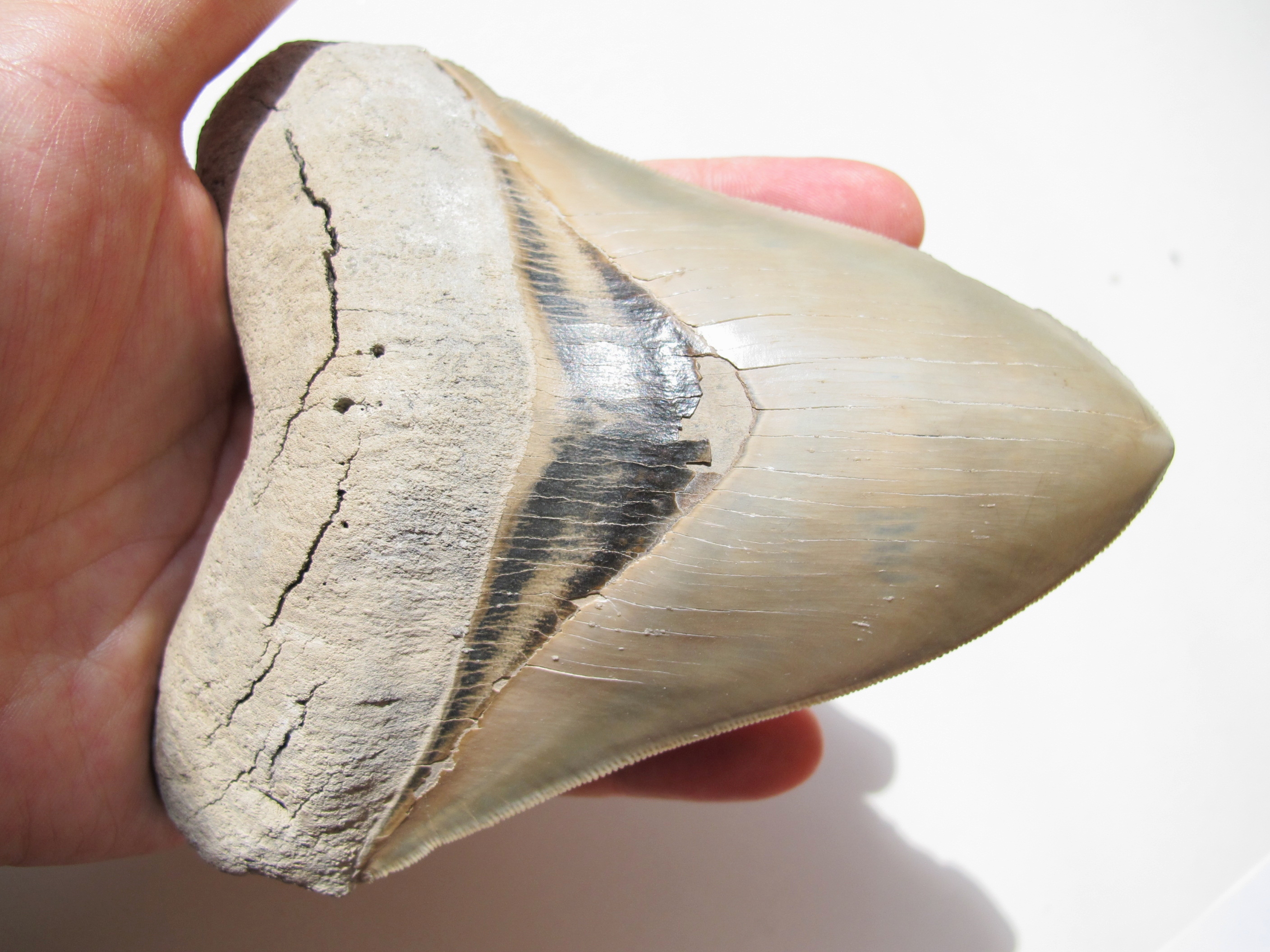
Authentic megalodon teeth share several consistent characteristics. The crown is broad and triangular with fine, regular serrations along both cutting edges. The root is thick, robust, and typically has a pronounced chevron shape (a V-shaped notch on the lingual, or tongue-facing, side). The enamel surface is smooth and may show a subtle bourlette, a slightly textured band where the enamel meets the root.
Forgeries typically involve one of several methods: carving teeth from bone or stone, compositing fragments of genuine teeth with modern filler material, or reshaping teeth from other large shark species to mimic megalodon proportions. Warning signs include suspiciously uniform coloration, visible tool marks, inconsistent enamel texture, artificial-looking serrations, and roots that appear too smooth or symmetrical.
The most reliable way to authenticate megalodon teeth in Florida is to collect them yourself from known geological deposits, eliminating any question of provenance. When purchasing specimens, buy from reputable dealers who can provide collection locality data and who offer return policies. Comparing any prospective purchase against verified museum specimens, such as those at the Florida Museum of Natural History or the Smithsonian National Museum of Natural History, is always worthwhile.
Size, color, and variation in Florida megalodon teeth
Size range
Megalodon teeth in Florida range from tiny juvenile teeth under one inch long to massive adult teeth exceeding seven inches from root to tip. The average collectible megalodon tooth falls in the two-to-four-inch range. Teeth over five inches are considered large and command significant collector interest, while specimens over six inches are genuinely rare and highly valuable. The largest megalodon teeth ever found approach seven and a half inches, and Florida has produced some of the world's largest known specimens.
Tooth size varied by position in the jaw. The largest teeth occupied the front-center positions of the upper jaw, where maximum bite force was concentrated. Lateral teeth (from the sides of the jaw) are progressively smaller and more asymmetrical, while posterior teeth are the smallest and most irregularly shaped.
Color variations
One of the most visually striking aspects of megalodon teeth in Florida is their wide range of colors. The original tooth material, primarily hydroxyapatite, is replaced during fossilization by minerals from the surrounding sediment, and the color of the finished fossil reflects the mineral environment in which it was preserved.
Black megalodon teeth are among the most common and are typically associated with phosphate-rich sediments like those of the Bone Valley Formation. The black coloration comes from phosphate minerals and organic carbon that permeated the tooth during fossilization. Gray megalodon teeth in Florida are also common and represent a lighter degree of phosphate mineralization or a different sediment chemistry.
Brown megalodon teeth range from light tan to deep chocolate and often come from sediments with high iron oxide content. Some Florida river systems produce teeth with distinctive brown, reddish-brown, or orange-brown coloration reflecting the iron-rich clays and sands of their geological formations. Less commonly, megalodon teeth in Florida display blue-gray, greenish, or even cream-colored hues, depending on the specific mineral cocktail of their burial environment.
Value and grading of megalodon teeth
Megalodon teeth in Florida range in value from a few dollars for small, damaged fragments to tens of thousands of dollars for large, museum-quality specimens. Several factors determine a megalodon tooth's collector value.
Size is the most obvious factor. Larger teeth command higher prices, with values increasing exponentially for teeth over five inches. A two-inch tooth might sell for $20 to $50, while a pristine six-inch specimen could command $1,000 to $5,000 or more. Record-size teeth have sold for over $50,000 at auction.
Completeness refers to how much of the original tooth is intact. A complete tooth with an intact root, undamaged blade, and full serrations is worth significantly more than one with chips, missing sections, or a partial root. Many megalodon teeth in Florida are found with some damage, as millions of years of geological pressure, transport, and exposure take their toll.
Serration quality affects value significantly. Sharp, well-defined, complete serrations along both cutting edges indicate excellent preservation. Worn, chipped, or missing serrations reduce a tooth's grade and value. Some collectors specifically seek teeth with feeding damage, chips and wear marks caused by the megalodon biting into hard prey during life, as these represent evidence of the animal's behavior.
Color and aesthetics also influence value. Uniformly colored teeth are generally preferred over mottled or stained specimens, and certain colors (jet black, rich brown) are considered more attractive by many collectors. Unusual or particularly vivid coloration can add a premium.
The Bone Valley Formation connection
No discussion of megalodon teeth in Florida is complete without a deeper look at the Bone Valley Formation, the geological unit that has produced more megalodon teeth than any other single formation in the state. The Bone Valley Formation was deposited during the late Miocene to early Pliocene, approximately 10 to 4 million years ago, in a shallow marine and coastal plain environment that covered much of central Florida.
The formation is characterized by phosphate-rich sands, clays, and gravels that accumulated in lagoons, estuaries, and shallow nearshore waters. These environments teemed with marine life, including megalodon, and the phosphate minerals in the sediment created exceptional conditions for fossil preservation. The same phosphate deposits that preserve megalodon teeth are mined commercially for fertilizer production, and the intersection of mining and paleontology has been one of the defining features of Florida fossil collecting for over a century.
Understanding the Bone Valley Formation and its relationship to other Florida geological units provides context for where and how megalodon teeth in Florida are distributed across the state. The Anastasia Formation, for instance, is a much younger geological unit that may contain reworked megalodon teeth eroded from older formations and redeposited in Pleistocene sediments. Our geological timeline places these formations in their proper chronological context.
Treasure Coast megalodon finds
The Treasure Coast holds a special place in the story of megalodon teeth in Florida. While not as prolific as the Peace River or Bone Valley, the beaches and waterways of St. Lucie, Martin, and Indian River counties have produced noteworthy megalodon specimens over the years. The Hawthorn Group sediments beneath the Treasure Coast contain Miocene deposits that occasionally yield megalodon teeth, particularly where erosion or dredging exposes these layers.
After significant storm events, megalodon teeth in Florida's Treasure Coast region wash up on beaches from submerged offshore formations. Divers working the nearshore waters off the Treasure Coast have also recovered specimens from fossil-bearing rock ledges and sediment pockets on the continental shelf. The same geological processes that deposited the diverse fossil assemblages found along the Treasure Coast placed megalodon teeth within reach of modern collectors.
Cleaning and preserving megalodon teeth
Proper cleaning and preservation of megalodon teeth in Florida ensures that your specimens remain in excellent condition for display and study. The approach depends on the condition of the tooth and the type of matrix (attached sediment or rock) present.
For teeth with loose sediment, gentle brushing with a soft toothbrush under running water removes most attached material. Avoid scrubbing the enamel surface aggressively, as even fossilized enamel can be scratched by abrasive particles in the attached sediment. For teeth with firmly attached calcium carbonate or limestone matrix, soaking in a dilute acid solution (white vinegar or a weak solution of muriatic acid) can dissolve the encrustation. Use acid only on the root and matrix areas, never on the enamel, and neutralize thoroughly with water and baking soda after treatment.
Teeth with cracks or fragile roots can be stabilized with Paraloid B-72, a conservation-grade acrylic resin that penetrates porous material and provides structural support without altering the tooth's appearance. For display, megalodon teeth are often mounted on small acrylic stands that support the root and allow the crown to be viewed from multiple angles.
Store megalodon teeth in Florida's humid climate with care. Rapid changes in humidity can cause expansion and contraction of the mineralized material, potentially leading to cracks. Keep specimens in a climate-controlled environment and avoid placing them in direct sunlight, which can fade coloration over time.
Frequently asked questions about megalodon teeth in Florida
How big do megalodon teeth in Florida get?
Megalodon teeth found in Florida range from less than one inch for juvenile teeth and lateral jaw positions to over seven inches for the largest anterior (front) teeth. The majority of collectible specimens fall in the two-to-four-inch range. Teeth over five inches are considered large, and specimens exceeding six inches are rare and highly prized. Florida has produced some of the largest megalodon teeth ever documented.
How much is a megalodon tooth worth?
Values vary enormously based on size, condition, and aesthetics. Small fragments or heavily damaged teeth may sell for $5 to $20. Complete teeth in the two-to-three-inch range typically sell for $20 to $100. Four-to-five-inch teeth with good preservation command $100 to $500. Specimens over five inches can bring $500 to $5,000 or more, depending on quality. Museum-grade specimens over six inches with perfect serrations and intact roots can sell for $5,000 to $50,000 or more at specialized auctions.
Where is the best place to find megalodon teeth in Florida?
The Peace River in central Florida is widely considered the most accessible and productive location for finding megalodon teeth in Florida. The Bone Valley phosphate region produces exceptional specimens but access is limited. Treasure Coast beaches yield occasional finds after storms. Venice Beach on the Gulf Coast and rivers in north Florida (Aucilla, Suwannee) also produce megalodon teeth. Each location offers different collecting experiences and tooth characteristics.
How can I tell if a megalodon tooth is real?
Genuine megalodon teeth have fine, regular serrations along both cutting edges, a thick robust root with a characteristic chevron-shaped notch, smooth enamel on the crown, and a weight and density consistent with fossilized material. Forgeries may show tool marks, inconsistent enamel texture, artificial-looking serrations, or suspiciously uniform coloration. The most reliable authentication comes from collecting teeth yourself from verified geological deposits. When purchasing, buy from reputable dealers who provide provenance information.
Why are megalodon teeth in Florida different colors?
The color of a megalodon tooth reflects the mineral environment in which it was fossilized. Black teeth are typically mineralized with phosphate and carbon from the Bone Valley Formation and similar deposits. Gray teeth represent lighter phosphate mineralization. Brown and reddish-brown teeth formed in iron-rich sediments. Occasional blue-gray, greenish, or cream-colored specimens reflect other mineral combinations. The color is permanent and was acquired over millions of years of chemical replacement of the original tooth material.