Why does Florida have so many sinkholes?
If you have lived in Florida for any length of time, you have seen the headlines: a driveway that opens overnight, a retention pond that appears where a lawn used to be, a stretch of highway closed while crews probe the ground beneath it. It is fair to wonder whether the state is somehow cursed. It is not. The reason Florida has so many sinkholes comes down to a single fact about what lies beneath your feet, and once you understand that fact, the whole pattern makes sense.
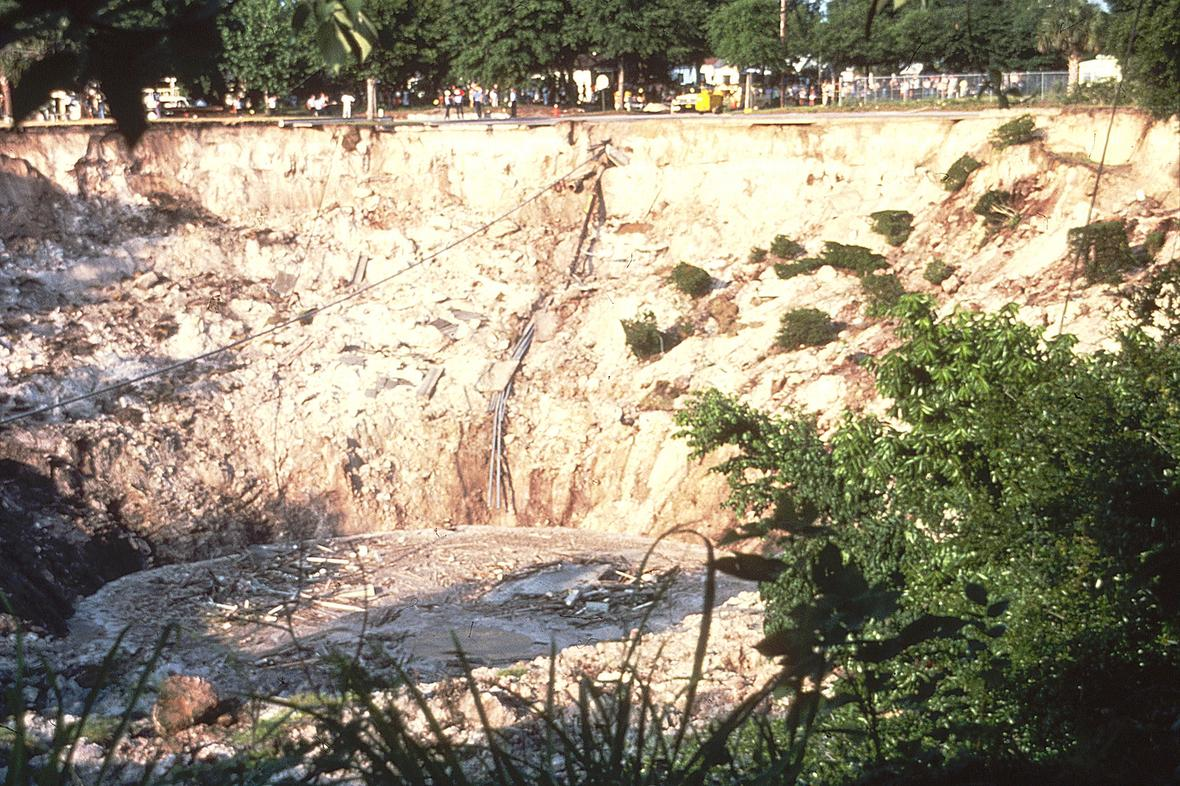
Florida is built on rock that dissolves
Most of us picture bedrock as permanent, the one thing under a house you never have to think about. Under Florida, that assumption does not hold. The foundation of the state is limestone, a carbonate rock made largely of calcium carbonate, the same mineral as seashells and chalk. Limestone has a property that granite and sandstone do not: it dissolves in weak acid. And Florida has a steady supply of weak acid falling on it every time it rains.
This limestone is not a thin surface layer. It is a platform thousands of feet thick, built up over hundreds of millions of years while Florida sat submerged beneath warm, shallow seas. Generation after generation of marine life lived, died, and settled to the seafloor, and their carbonate remains compacted into rock. Our geological timeline traces that long submersion in detail. The short version is that Florida is, quite literally, an old seabed lifted just above the waves, and the seabed is made of the one common rock that water can eat.
How rainwater turns solid rock into open space
The process that makes sinkholes is slow, quiet, and entirely predictable. It works like this:
- Rain picks up acid on the way down. As rainwater falls and then soaks through soil, it absorbs carbon dioxide from the air and from decaying plant matter. That carbon dioxide reacts with the water to form a weak carbonic acid. This is the same mild acid that gives sparkling water its bite. It is nowhere near strong enough to harm you, but it is more than strong enough to work on limestone.
- The acid seeps into the rock. Limestone is full of cracks, joints, and tiny pore spaces. The mildly acidic water follows those pathways downward, and everywhere it touches the rock, it dissolves a little of it away, carrying the dissolved mineral off in solution.
- Cavities grow over time. Repeat that for thousands of years and the small pathways widen into a connected network of gaps, channels, and hollows. Geologists call a landscape shaped this way karst terrain, and Florida is one of the largest karst regions in the country.
- The surface finally gives way. A cavity underground does not create a sinkhole on its own. The sinkhole appears when the soil and sediment arching over the cavity can no longer support their own weight. At that point the ground above sinks or collapses into the space below.
Every Florida sinkhole is the last step of that sequence. What varies from place to place is how fast the collapse comes and how dramatic it looks, and that depends on what sits between the surface and the limestone. Our main guide to Florida sinkholes breaks down the three collapse types in full.
Why Florida and not its neighbors?
Limestone is not unique to Florida. Parts of Kentucky, Tennessee, and Missouri sit on karst too. So why does Florida so consistently lead the country in sinkhole reports? Three conditions line up here in a way they rarely do elsewhere.
- The limestone is everywhere, and it is close. The carbonate platform underlies the entire state, and across large stretches of Florida it sits within reach of the surface rather than buried miles down. The dissolving rock is near enough to affect the ground people build on.
- Water is constant and abundant. Florida receives heavy rainfall and holds an enormous volume of groundwater in the Floridan Aquifer, the water system that fills the porous zones of the limestone itself. Dissolution needs water moving through rock, and Florida supplies that in quantity, year after year.
- A patchy clay blanket sets the stage for sudden collapse. Across much of the peninsula, a clay-rich layer known as the Hawthorne Group lies between the surface sands and the limestone below. Where that clay is intact and thick, it shields the limestone and slows sinkhole activity. But where it has thinned or partly eroded, it can bridge a growing cavity like a lid over a jar, holding for years before failing all at once. That combination, soluble rock below and a failing clay lid above, produces the sudden, headline-making collapses.
Where all three conditions meet, sinkholes are most frequent. That is why reports cluster in west-central Florida, the Tampa-to-Orlando belt often called Sinkhole Alley, rather than spreading evenly across the map. The regional breakdown in our main sinkhole guide maps where the risk runs highest and where, like along the Treasure Coast, an intact confining layer keeps it lower.
What turns a slow process into a sudden drop
The dissolution that hollows out the rock takes thousands of years. The collapse that follows can take minutes. What tips one into the other is usually a change in water.
The groundwater in the Floridan Aquifer does more than dissolve rock. It also helps hold up the sediment above a cavity, buoying it from below. When the water table drops, that support weakens. This is why sinkhole reports rise during droughts, exactly when demand for water is highest and the aquifer is drawn down lowest. Heavy rain after a dry spell can push the other way, suddenly loading saturated soil onto a weakened cavity roof. Nearby well pumping and construction that changes drainage can nudge a marginal cavity past its tipping point as well. None of these triggers create a sinkhole from nothing. They release one the geology had already prepared.
So is my property at risk?
Understanding why Florida has sinkholes is the first step toward answering the question every homeowner actually asks. The honest answer is that risk depends heavily on where you are. The geology that produces sinkholes is real statewide, but it is not evenly distributed, and some regions carry meaningfully lower risk than the reputation suggests. The Treasure Coast is one of them, thanks to a generally intact Hawthorne confining layer and the stable near-surface Anastasia Formation along the coast.
For the warning signs to watch for, what a geological assessment involves, and how sinkhole insurance works in Florida, see the safety and regional sections of our complete guide to Florida sinkholes. If you are weighing a specific site, the Florida Geological Survey publishes subsurface data and maps that a licensed geotechnical engineer can read against your parcel.
Frequently asked questions
Does Florida really have more sinkholes than any other state?
Florida is consistently ranked among the most sinkhole-prone states in the country, and it reports sinkhole activity more often than any other. The reason is the combination described above: a thick, near-surface limestone platform, abundant groundwater, and a patchy clay confining layer. Some other states have karst geology, but few have all three conditions across such a large area.
Is the limestone under Florida going to run out?
No. The carbonate platform is thousands of feet thick, so dissolution is not going to consume it on any human timescale. The geological conditions that produce sinkholes are effectively permanent. What changes over time is not the rock but the human factors that trigger collapse, such as groundwater pumping and land development, and those are the parts within our control.
If limestone dissolves in acid, why doesn't all of Florida just collapse?
Because the process is extraordinarily slow and uneven. Rainwater is only mildly acidic, dissolution proceeds over thousands of years, and in many places a thick, intact clay layer shields the limestone entirely. Cavities form here and there, not everywhere at once, and most never grow large enough or shallow enough to reach the surface. Sinkholes are the exception, not the rule, even in Florida.
Why do sinkholes seem to happen more during droughts?
Groundwater helps support the sediment arched over an underground cavity. During a drought the water table drops, that support weakens, and cavities that were stable can fail. Drought is also when water demand and pumping peak, which draws the aquifer down further. The dissolution happened long before; the dry conditions simply remove the last thing holding the ground up.